Most fitness coaches love program design, client relationships, and getting people results. Marketing and content creation, not so much. But if you want a full client roster and a stable business, your personal brand and content strategy cannot sit on the sidelines.
Week 9 of the OPEX Method mentorship dug into how coaches can show up online in a way that feels honest, aligned, and effective. Instead of chasing trends or hacks, the focus was on building a content approach rooted in beliefs, values, and real coaching skills.
This recap walks through the big ideas from the week: how the internet has changed, why personal brands matter so much for coaches, the Coaching Content Signature framework, and how to think about marketing without feeling like a sellout.
Week 9 Focus: Content As An Extension Of Your Coaching
The main theme for the week was simple and powerful: treat content like coaching, not like a performance.
The goal was to help coaches build a foundation for their personal brand strategy with a clear focus on content. That meant answering questions like:
How do you present yourself through your content in a way that reflects your core values?
How do you show the real value of your coaching service without feeling salesy?
How do you speak to the exact type of client you want, using shared beliefs instead of gimmicks?
The group explored content as a trust-building tool, not just an acquisition tool. When you create a body of work that reflects what you believe, how you think, and how you coach, you do a few things at once:
Attract the right people and quietly repel the wrong ones.
Pre-qualify future clients before they ever book a call.
Serve current clients better by giving them more education and clarity.
It is less about trying to be internet famous and more about building real connection at scale.
How Marketing Has Shifted: From Information To Attention To Perspective
To put content strategy in context, the group looked at how the internet has changed over the last 20-plus years.
Era 1: Information (roughly 2000 to 2010)
In the early 2000s, the big advantage online was access to information. If you knew a lot and could explain it clearly, you could stand out.
For coaches, that often meant:
Long-form blog posts
Articles that ranked in search
Teaching through written content
Search behavior mattered a lot. If you understood what people were typing into Google and wrote useful content around those topics, you could grow without ever posting a video.
Era 2: Attention (roughly 2015 to now)
Over the last decade, the internet has shifted toward an attention race. Social feeds, endless scroll, and rich media have taken over.
Now most people are:
Competing in the same feeds for the same limited attention
Posting short-form video, reels, and stories
Using hooks, trends, and formulas that all start to look the same
On top of that, AI has made it much easier to create more content, faster. The result is a flood of similar posts, similar hooks, and similar angles. Content becomes very skippable, because nothing feels new.
Creators are tired of making it, and consumers are tired of watching it.
Era 3: Perspective (where we are heading)
Week 9 introduced a third phase, which is already starting to show up: the era of perspective.
Information is everywhere. Attention is harder to hold. What keeps someone with you is not just what you know, it is how you see the world and how you help them see it differently.
Coaches do this every day in their sessions:
Reframing a client’s struggle
Helping them see what is actually in their way
Giving them a clearer, more hopeful picture of their path from A to B
That same skill, when used in content, becomes your advantage. You still need to grab attention for a second or two, but what keeps people watching, reading, and coming back is your unique point of view.
Here is a simple summary of the three phases:

The takeaway for coaches: you do not need to change who you are, you just need to adjust how you deliver your ideas so they land in the current environment.
The Coaching Content Signature: Your Personal Brand Framework
The core tool for the week was something called the Coaching Content Signature. It is a simple framework for building a personal brand content strategy that feels like you, not like a template you copied from someone else.
It has three main parts:
What you believe
What you talk about
How you show up
When those three overlap, you start to create a “market of one” around your coaching.
1. What you believe
This is the anchor.
Coaches were asked to get clear on the core beliefs that drive their practice. Things like:
What you believe about long-term health and fitness
What you believe about client responsibility and coach responsibility
What you believe about quick fixes, complexity, and consistency
This connected strongly to the PVMV work that is part of the OPEX Method, around purpose, vision, mission, and values.
Beliefs matter because they:
Shape how you coach
Filter who you want to work with
Help the right people feel, “This coach sees the world like I do”
Content that comes from beliefs has more weight. It is not just “5 tips for X,” it is “Here is how I think about this problem, and why.”
2. What you talk about
Next, coaches mapped what they talk about through the lens of their target client.
That meant getting clear on:
Pain points and frustrations
Frictions and obstacles
The questions they Google at 10 p.m. when they should be sleeping
The results they wish they had
The magic happens where what you believe overlaps with what they care about. That overlap is where your unique perspective shines.
Instead of posting generic content like “3 shoulder mobility drills,” you might share:
Why most mobility routines fail
What you believe people actually need instead
How that belief shapes the way you build programs
Same topic, completely different level of connection.
3. How you show up: style and tone
The third piece is your style and tone, the way your presence comes across.
This includes:
Your energy on camera or audio
Your word choice and pacing
The way you shoot and light your videos
The vibe people feel when they see your content
Something as simple as lighting can send a different signal. For example, a bright setup can feel more energetic and open, while a darker, “moody” setup can feel more reflective or intense.
Style is not about acting like someone else. It is about aligning the way you show up with who you are and who you want to attract, so content does not feel like a performance.
When beliefs, topics, and style line up, content becomes “bingeable.” Someone can go down the rabbit hole of your posts, start to feel like they know you, and arrive at a sales call already warm and pre-qualified.
Helping Coaches Care About Marketing
Many coaches see marketing as a necessary evil. Some even see it as an unnecessary one.
They got into coaching because they care about impact and mastery, not because they want to spend all day planning content or tracking engagement.
Week 9 worked hard to reframe that.
A few key points landed:
You are not chasing virality. The goal is not views at any cost, it is aligned connection.
You already care about impact. Content lets you help more people than you could ever fit on your roster.
You already care about mastery. Content forces you to sharpen your thinking, your explanations, and your coaching language.
When you treat content like training, it becomes more approachable. You get better rep by rep. Each piece is a quality attempt, not a random effort. Over time your clarity, skill, and ease in front of the camera all improve.
Content also feeds your existing clients. You can send them posts or videos that explain concepts in more depth, give them support between sessions, and help them feel more understood.
Marketing then stops being separate from coaching. It becomes a natural extension of it.
Differentiation, Impostor Syndrome, and Honest Marketing
Positioning yourself as “the product” can feel uncomfortable.
Coaches in the mentorship voiced familiar thoughts:
“Who am I to speak on this?”
“Is what I offer really that different?”
“Do I need endless new certifications to stand out?”
One helpful reminder was that OPEX Method coaches already have meaningful differentiation baked in. The method itself, with individual design, lifestyle coaching, and deep client relationships, is not the default approach in the market.
On top of that, no one else shares your exact mix of:
Personality
Values
Opinions
Life experience
You are already a market of one. The work is not to invent a new persona, it is to express what is already there with more honesty and intention.
The conversation also touched on “cult” energy, in a neutral sense. Humans have always gathered around people and ideas they feel devoted to. Some coaches naturally want to build a bigger personal platform, others are quieter. Both are fine, as long as the marketing stays honest.
Good marketing, in this context, is:
Truthful about what people will get and how they will feel
Connected to your real beliefs and values
Backed up by strong delivery and client care
In other words, aligned.
What Is Coming Next Inside The OPEX Method
Week 9 set the personal brand and content foundation. Next up in the mentorship is a more tactical mix of:
Building the basic infrastructure for online demand generation, so coaches are not relying only on referrals.
Offer development and packaging, so the value exchange is clear to both coach and client.
Improving delivery, so what is promised in marketing matches the client experience.
For coaches who want to go deeper into this type of work, the next OPEX Method cohort starts on January 13, with enrollment closing January 9. You can learn more about the OPEX Method coaching education program and book a call with the team to see if it is a fit.
Final Thoughts
Week 9 was not about turning coaches into influencers. It was about helping them see content and personal brand as tools for trust, clarity, and impact.
If you know what you believe, understand who you want to help, and are willing to show up as yourself, you already have everything you need to build a meaningful presence online. The strategy and structure just help you do it with less stress and more consistency.
The next step is simple: treat your next piece of content like a coaching rep, not a performance, and let your perspective do the heavy lifting.
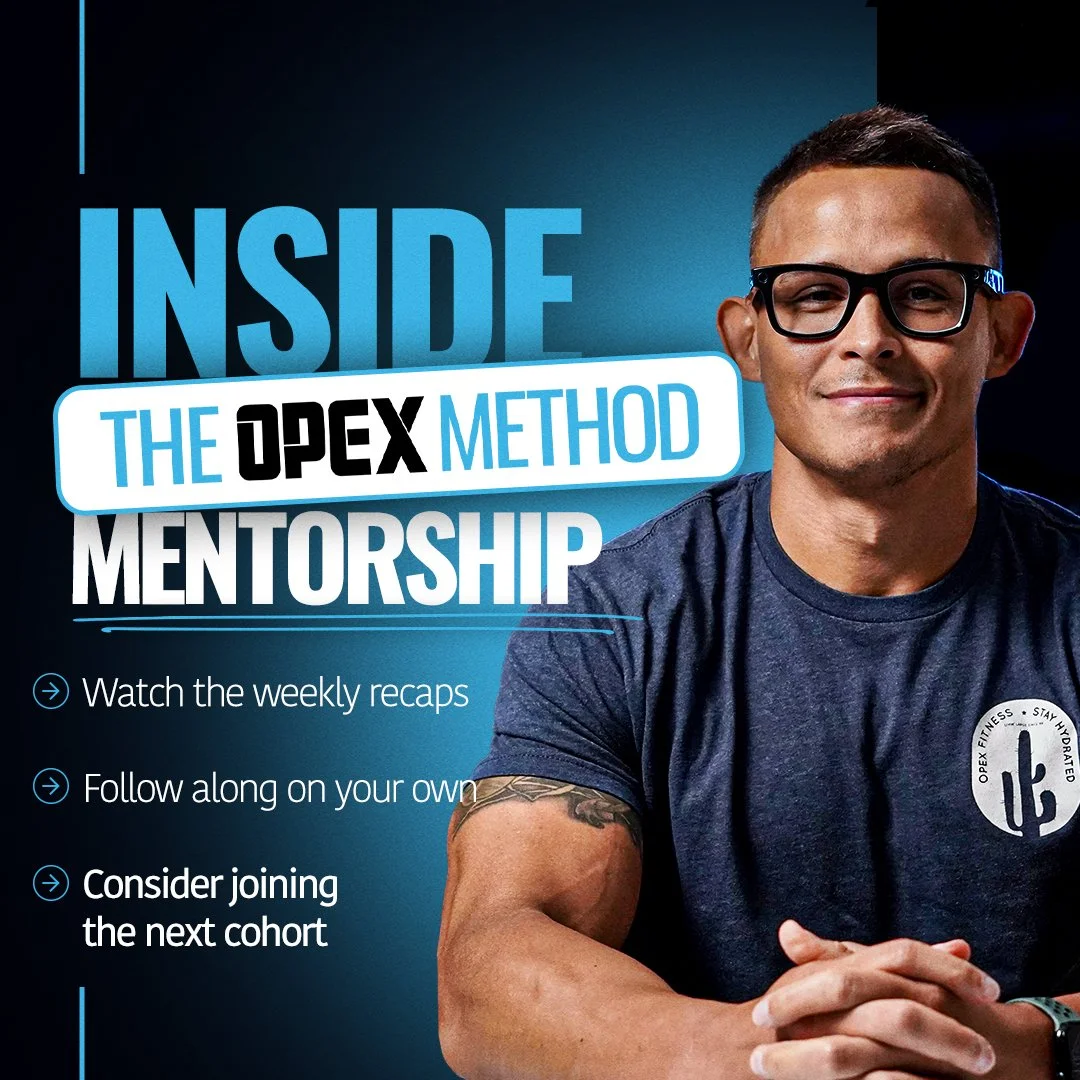
The livestream runs across YouTube, LinkedIn, and Facebook. Questions are welcome during the stream and after. If you have a question, add it in the comments where you watch.
The team reviews them and answers in the next live session. There are no silly questions. If something is blocking you, someone else is likely stuck on the same thing.
Curious about joining a future cohort or want the full curriculum?
Get the overview and next steps inside the OPEX Method mentorship and CCP Level 1.
Next Steps
Become A Professional Coach.
Wherever you are on your coaching journey, learn a repeatable and proven system to simplify program design and build a sustainable career. See how the OPEX Method Mentorship can help you find your version of success as a professional coach.
Elevate Your Coaching Business
CoachRx empowers fitness coaches to excel in program design, nurture client relationships, and scale their businesses with unparalleled efficiency and insight. Discover why CoachRx is the preferred choice for fitness coaches seeking to differentiate and deliver exceptional services.
Continue To Learn & Grow
Whether you want to write better training programs, increase your knowledge of nutrition & lifestyle protocols, or work on your coaching business, LearnRx has got you covered with courses, playlists, tools, and resources on demand. New content added monthly.